 ForsaEduforsaedu.com
About the scholarship program
Dublin City University (DCU) in Ireland offers merit-based international scholarships for non-EU students in undergraduate and postgraduate programs, usually as tuition-fee reductions. Some awards are considered automatically on admission. Values and conditions are published annually on the international scholarships page.
Available programmes
Each programme has its own requirements, documents and benefits. Open it to see them in full with the application steps:
- View Details
Dublin City University Faculty International Scholarships 2027–2028
Bachelor, MasterPartially Funded36 majorsJuly 1, 2027
Life and living
Dublin · Ireland
Life and living
Dublin · Ireland
Living in Dublin
Ireland’s capital and Europe’s base for big tech, home to Trinity College and University College Dublin — but housing is expensive and scarce.
Student housing
Trinity College 2026/27: campus rooms from EUR 185 a week, Kavanagh Court EUR 325, Here! Cork Street EUR 303–349.50 a week.
Transport for students
The Student Leap Card halves fares: EUR 1 for a 90-minute fare, capped at EUR 3 a day and EUR 12 a week (2026).
Top landmarks
Trinity College and the Book of Kells
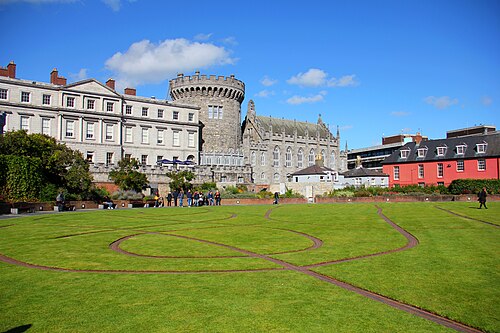
Dublin Castle
J.-H. Janßen · CC BY-SA 3.0 · Wikimedia Commons
St Stephen’s Green
St Patrick’s Cathedral
Last verified: October 2026
Sources:CSO – Census 2022Trinity College Dublin – Accommodation 2026/27Study in Ireland – Essentials and cost of living
Studying and living in Ireland
Costs and living
• Non-EU International Tuition Fees: - Undergraduate: €10,000 to €22,000 per year (up to €35,000+ for clinical medicine). - Postgraduate / Master’s: €12,000 to €26,000 for the full 1-year programme. • Living Expenses & Accommodation: - Dublin (Capital): €1,200 to €1,800 per month including rent, utilities, food, and student travel. - Other cities (Cork, Galway, Limerick): €900 to €1,300 per month.
Working while studying
Working Rights & Post-Study Work Visa (Stamp 1G): • During Studies (Stamp 2): Students are legally permitted to work part-time up to 20 hours per week during term time, and up to 40 hours per week during vacation periods (June–September and Christmas holidays). Minimum wage is among the highest in Europe (€14.15/hour since January 2026). • Third Level Graduate Programme (Stamp 1G): - Master’s & PhD graduates (NFQ 9/10): 2-year (24 months) stay-back work permit allowing full-time employment. - Honours Bachelor graduates (NFQ 8): 1-year (12 months) stay-back work permit. Leads directly to the Critical Skills Employment Permit and long-term European residency.
Last verified: October 2026· Source
Guide to studying in IrelandFaculties and programmes
5 faculties · 51 programmes
Faculties and programmes
5 faculties · 51 programmes
Programmes taught at each faculty, with study levels and teaching language where the university publishes them. Admission and funding differ per programme.
DCU Business School
BachelorMasterPhDENEnglish- Accounting
- Business Management
- Data Science & Analytics· Master
- Entrepreneurship
- Finance
- Human Resource Management
- International Business
- Marketing
- Supply Chain Management
Faculty of Engineering and Computing
BachelorMasterPhDENEnglish- Artificial Intelligence
- Biomedical Engineering
- Computer Science
- Cybersecurity· Master
- Data Science & Analytics· Bachelor, Master
- Electrical Engineering
- Industrial Engineering· Bachelor, Master
- Information Technology (IT)· Bachelor, Master
- Mechanical Engineering
Faculty of Humanities and Social Sciences
BachelorMasterPhDENEnglishGAIrish- Business Management· Bachelor, MasterGA
- Corporate LawEN
- Criminal LawEN
- Digital MediaEN
- Film & Television Production· MasterEN
- Human Rights LawEN
- International LawEN
- International RelationsEN
- JournalismEN
- Languages and Literature
- Political ScienceEN
- PsychologyEN
- Public Relations· MasterEN
- TranslationEN
Faculty of Science and Health
BachelorMasterPhDENEnglish- Biology
- Chemical Engineering· Master
- Chemistry
- Environmental Science
- Mathematics
- Medical Laboratory Sciences· Master
- Nursing
- Pharmacy· Bachelor
- Physical Therapy· Master
- Physics
- Public Health· Bachelor, Master
- Sports Science
- Statistics· Bachelor, Master
Show all faculties (+1)Show less
DCU Institute of Education
BachelorMasterPhDENEnglishGAIrish- Curriculum & Instruction
- Early Childhood EducationEN
- Educational PsychologyEN
- Music· Bachelor, MasterEN
- Special EducationEN
- Theology & Religious Studies· Bachelor, MasterEN
Frequently Asked Questions (FAQ)
Key questions and answers regarding eligibility, documents, and application steps.
Funding type: Partially Funded. Announced benefits: €1,850–€6,100 fee reduction.
The latest deadline we have is July 1, 2027. Dates can differ by university or programme, so confirm on the official website.
Required documents: Programme application, Transcripts and English test result.
Apply directly on the official website: https://www.dcu.ie. ForsaEdu does not receive applications or charge any fee.
QS World University Rankings 2026
Rank#410
Track your academic readiness
Use the checklist in your profile to prepare your documents and make sure you meet this scholarship’s requirements.
Open readiness checklistSimilar scholarships

 IrelandQS #401
University of Limerick
The University of Limerick in Ireland offers scholarships and bursaries for international undergraduate and postgraduate students, usually as tuition-fee reductions based on academic merit or country. Some awards are considered automatically on admission, while others require a separate…
 IrelandQS #75
Trinity College Dublin
Trinity College Dublin, Ireland's oldest university, offers Global Excellence Scholarships to non-EU students in undergraduate and postgraduate programs, usually as tuition-fee reductions based on academic merit. Scholarships for specific countries or programs are also available. Award values and…
 IrelandQS #118
University College Dublin (UCD)
University College Dublin (UCD), Ireland's largest university, offers Global Excellence Scholarships to non-EU students in postgraduate and undergraduate programs, usually ranging from a partial fee reduction to a full tuition waiver. You generally need an offer of admission to the program and then…